


Urine drug screens (UDSs) are used in opioid treatment programs to help clinicians track patient progress, adjust treatment plans, and address potential risks. At Community Medical Services, we’ve gathered extensive data from UDS results to understand trends over time and how these results affect other important outcomes, such as patient retention and Social Determinants of Health (SDOH).
With over 2 million documented tests since 2004, our UDS data provides a detailed picture of the substances our patients use and how their use changes throughout treatment. This article explores our key findings, including trends in opioid, fentanyl, and amphetamine use, as well as the connection between drug screen results, retention rates, and social factors like employment and housing.
By analyzing these trends, we can refine our treatment strategies to better support our patients, help them stay in treatment, and improve their overall quality of life.
Urine Drug Screens and Patient Retention: An Overview
- Why Are Urine Drug Screens Used in Opioid Treatment Programs?
- UDS at CMS: What We Test For
- Trends in CMS UDS Results
- Fentanyl and Amphetamine Positivity Over Time
- State-Specific UDS Results: Variations in Fentanyl and Amphetamine Positivity
- The Impact of UDS Results on Treatment Retention
- Impact of UDS Results on Social Determinants of Health (SDOH)
- Frequently Asked Questions About Urine Drug Screens in OUD Treatment
- How CMS is Improving Treatment with UDS Data
Why Are Urine Drug Screens Used in Opioid Treatment Programs?
In an opioid treatment program (OTP), urine drug screening is best understood as a clinical monitoring tool, not a standalone judgment about whether a patient is “doing well” or “failing” treatment. Drug tests identify the presence or absence of specific drugs or metabolites within a limited detection window, so they are most useful when interpreted alongside the patient’s history, symptoms, medication adherence, and broader treatment goals. This patient-centered approach is increasingly aligned with federal OTP guidance, which treats opioid use disorder (OUD) as a chronic condition requiring ongoing, individualized care.
UDS at CMS: What We Test For
As of March 2023, Community Medical Services had almost 2.3 million documented urine drug screen tests. These tests provide critical insights into what substances our patients use and help inform treatment plans and strategies. The drugs we routinely test for include:
- Fentanyl
- Opiates (including heroin, hydrocodone, codeine, and morphine)
- Oxycodone
- Barbiturates
- Benzodiazepines
- Cocaine
- Amphetamines (including methamphetamine)
- Buprenorphine
- Methadone
- Methadone metabolites
A standard opioid screen does not answer every question a care team may have, especially in an era when illicitly manufactured fentanyl has become the dominant opioid in the U.S. drug supply. In response to the growing fentanyl crisis, we’ve added tests for fentanyl. This gives our clinicians a more accurate picture of recent substance exposure, medication presence, and emerging regional trends that may affect induction, stabilization, and overdose risk. Importantly, we do not routinely test for cannabis unless required by state regulations or ordered explicitly by a medical provider, but we do test for medications we administer, including methadone, methadone metabolites, and buprenorphine.
We conduct most of our testing at our lab in Scottsdale, but some states require external labs. All results are uploaded into our Electronic Health Record (EHR) and transferred to the Data Warehouse, where we conduct our analyses using Databricks. We currently perform close to 100,000 tests each quarter, and this extensive data collection allows us to track trends in substance use and improve the effectiveness of our treatment programs.
Trends in CMS UDS Results
As we analyze UDS data over time, we can observe clear trends in opioid and fentanyl use among our patients. One of the most notable findings is the sharp rise in fentanyl positivity. Fentanyl began appearing in our tests around late 2019, and it has since become one of the most frequently detected substances. By early 2024, over one-third of all tests conducted at CMS were positive for fentanyl. In contrast, the percentage of tests positive for other opiates, such as heroin and prescription opioids, has been steadily declining over the same period. However, recently we have seen a decline in fentanyl positivity – this may be related to the increase in use of kratom and 7-OH, which are not detected on routine UDS testing. While kratom can be detected with advanced testing (which must be sent to a reference laboratory and is expensive), there is currently no test certified available for routine testing.

The rate of oxycodone positivity has remained stable, hovering around 1-2%, which is relatively low compared to other opioids. This suggests that while fentanyl has surged in prevalence, the use of other opioids has either stabilized or decreased.
To better understand these trends, it’s important to look at the timing of tests within the patient’s treatment journey. Not all tests focus on newly admitted patients; many of our tests involve individuals who have been in treatment for extended periods. The majority of UDS tests—more than 75%—are conducted on patients who have been in treatment for over two years. The graph below shows the percentage of patients who test positive upon admission for fentanyl, opiates, or oxycodone:

The percentage of opioid positivity on admission shows a similar trend as the overall rate for all tests, with an increase in fentanyl positivity and a decrease in opiates, with a minority of tests positive for oxycodone.
The graph below shows the percentage of patients who test positive at the time of admission for drugs other than opioids – amphetamine, cocaine, and benzodiazepines.

The percentage of patients positive for amphetamine on admission (mostly due to illicit methamphetamine use) has been increasing dramatically over the last few years.
Fentanyl and Amphetamine Positivity Over Time
One of the most concerning trends observed in our UDS data is the persistently high rate of fentanyl and amphetamine positivity, even among patients who have been in treatment for extended periods. While the percentage of positive tests declines as time in treatment increases, a significant number of patients continue to test positive for these substances long after their initial intake. This data provides insights into the long-term challenges patients face, particularly with substances like fentanyl, even after extended time in treatment. Our data shows that patients who are positive for amphetamines on admission face increased challenges and are more likely to leave treatment than those who do not test positive.

For example, approximately one-fourth of patients who have been in treatment for over two years still test positive for fentanyl. Similarly, about 16% of patients in this group test positive for amphetamines. This data highlights a critical reality: many patients do not become fully abstinent, even after years of treatment.
Despite this ongoing substance use, patients must remain in treatment. From a clinical standpoint, persistent fentanyl or amphetamine positivity over time should not be interpreted too simplistically. OUD is a chronic, treatable illness, and while the data shows that complete abstinence may not be achievable for all patients, it also highlights that staying in treatment provides significant health benefits, such as reducing overdose risk and improving overall health and stability. Rather than discharging patients based on UDS results, it’s essential to continue supporting them through treatment, helping them “stay alive and thrive.”
State-Specific UDS Results: Variations in Fentanyl and Amphetamine Positivity
While the overall trends in fentanyl and amphetamine use are alarming, there are significant variations in UDS results depending on the state. This regional variation highlights how the opioid crisis and substance use patterns can differ widely across the country, influencing treatment strategies and outcomes. The following tables show the percentage of positive UDS results on admission for fentanyl and amphetamine across several of the states CMS serves:
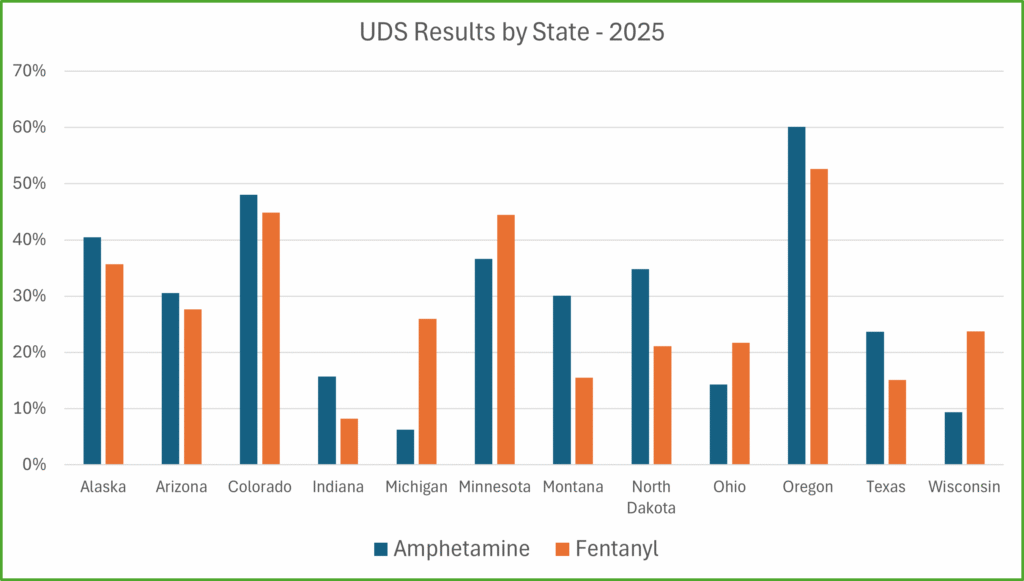
During 2025, Oregon had the highest percentage of fentanyl-positive tests, with Alaska, Colorado, Michigan, Minnesota, and Wisconsin also reporting high percentages of fentanyl positivity. In contrast, states like Indiana, Montana, and Texas showed lower fentanyl positivity rates, though they remain concerning.
Amphetamine use, on the other hand, displays a different regional pattern. Alaska, Colorado, Minnesota, North Dakota, and Oregon reported the highest percentages of amphetamine positivity at admission. Conversely, Indiana, Michigan, Ohio, and Wisconsin showed much lower rates of amphetamine use but exhibited higher rates of cocaine use. These variations in stimulant use suggest that different regions may have distinct substance use trends, which require tailored treatment approaches.
Understanding these state-level variations is crucial for developing targeted treatment plans that address the specific needs of patients based on their region. By identifying these trends, CMS can better allocate resources and customize care strategies to combat the unique challenges faced in each state.
The Impact of UDS Results on Treatment Retention
The connection between urine drug screen results and patient retention in treatment is an important factor for understanding the long-term success of opioid treatment programs. At CMS, we’ve observed that positive UDS results, particularly for fentanyl and amphetamines, have a clear impact on 30-day retention rates.
Patients who test positive for fentanyl at admission have a lower retention rate compared to those who do not. Specifically, the retention rate for fentanyl-positive patients drops from 80% to 70% after 30 days. The effect of amphetamine positivity is even more pronounced: those who test positive for amphetamines at admission have a 30-day retention rate of just 65%. This highlights that amphetamine use presents a significant challenge for patient retention.
Patients who test positive for both fentanyl and amphetamines have a retention rate like those who test positive for amphetamines alone, hovering around 65%. These results suggest that amphetamine use may be a stronger predictor of lower retention than fentanyl alone, indicating that patients using amphetamines face additional challenges in maintaining their engagement with treatment.
These findings underscore the importance of early intervention and continued support for patients who test positive for these substances. While fentanyl and amphetamine use are associated with lower retention, keeping patients in treatment and providing comprehensive care can help mitigate these risks and improve long-term outcomes.
Methadone and buprenorphine are associated with lower overdose mortality, and national guidance emphasizes that medications for OUD should not be withheld simply because a person continues to use other substances. For that reason, a positive admission UDS should often be viewed as a signal for closer engagement, medication optimization, and added support, not automatic discharge or treatment failure.
Impact of UDS Results on Social Determinants of Health (SDOH)
In addition to affecting retention, UDS results have a significant relationship with Social Determinants of Health (SDOH), such as employment and housing stability. By analyzing these factors alongside drug test results, we can better understand the broader implications of substance use on patients’ lives.
For patients who test positive for fentanyl upon admission, the data shows little to no impact on their employment or housing status at the time of intake. This is likely because fentanyl use has become so widespread among our patient population. Patients who test negative for fentanyl on admission may not have used fentanyl in the prior few days, but they may still have a history of fentanyl use before that time frame.
However, the picture changes when looking at amphetamine use. Patients who test positive for amphetamines on admission are less likely to be employed and more likely to have unstable housing than those who test negative. The data indicates a strong link between methamphetamine use and adverse SDOH outcomes. This is likely due to the specific effects of amphetamine use, which can have a more immediate and disruptive impact on a person’s ability to maintain employment and housing.
These findings highlight the importance of addressing both the substance use disorder and the social challenges that come with it. For patients struggling with amphetamine use, targeted interventions that focus on employment support, housing assistance, and mental health services are essential to improving their overall stability and success in treatment. Clinical outcomes are not only shaped by substance exposure, but also by the stability and support surrounding each patient.
Frequently Asked Questions About Urine Drug Screens in OUD Treatment
Why are urine drug screens important in medication-assisted treatment?
Urine drug screens can help providers adjust care plans based on what a patient is experiencing in real time. UDS results can reveal patterns in fentanyl, opioid, and amphetamine use, while also helping clinicians understand how those patterns may affect treatment retention, housing stability, and employment.
Why is fentanyl testing so important in opioid treatment today?
Our data shows that fentanyl positivity has increased sharply in recent years and became one of the most frequently detected substances. Fentanyl began appearing in CMS tests around late 2019, and by early 2024, more than one-third of all tests were positive for fentanyl, making it a major factor in treatment planning and patient monitoring.
Does a positive urine drug screen mean treatment isn’t working?
Not necessarily. Many patients continue to test positive for fentanyl or amphetamines even after extended time in treatment, but remaining in treatment can still provide important benefits such as improved stability and reduced overdose risk. Continued support rather than discharging patients solely because of ongoing substance use is essential to long-term recovery.
Why is amphetamine or methamphetamine positivity especially concerning in treatment?
Amphetamine positivity may present a particularly strong challenge for retention and stability. Our data highlights that amphetamine-positive admission screens correlate directly with a lower 30-day retention and poorer social outcomes, including lower employment rates and more unstable housing at intake.
How CMS is Improving Treatment with UDS Data
The data we’ve gathered offers valuable insights into the challenges faced by patients in treatment for opioid use disorder, particularly regarding fentanyl and amphetamine use. One of the most important takeaways from our analysis is the need to keep patients in treatment, even if they continue to test positive for substances.
The data shows that many patients, especially those who test positive for fentanyl at admission, continue to test positive even after a year or more in treatment. While abstinence may not be achievable for all patients, staying in treatment offers significant benefits, such as reducing the risk of overdose and improving overall health. By accepting that some patients may never entirely abstain from substance use but can still experience improvements in stability and health, we can better support their recovery journey.
The trends and data CMS has collected provide a roadmap for improving treatment outcomes and addressing the complex needs of our patients. From recognizing the importance of keeping patients in treatment despite ongoing substance use to understanding the social and demographic factors that influence recovery, this data shapes the future of opioid treatment programs at CMS.
At a program level, longitudinal UDS data can function as an early warning system. When viewed over months and years, these results help an opioid treatment program monitor shifts in the illicit drug supply, identify populations at higher risk for early dropout, and align services with real-world patient needs. That kind of measurement is especially important in a treatment environment shaped by fentanyl exposure, stimulant co-use, and the need for long-term retention rather than short-term abstinence alone.
By focusing on long-term retention, addressing social challenges, and tailoring treatment to specific patient needs, we can continue to progress in helping our patients “stay alive and thrive.” If you or a loved one is looking to start your journey toward recovery, find a CMS clinic near you today.